
Himalayan layers: creative photography in Nepal

Cities, people and mountains
On February 2024 I went to Nepal.
Like most of my trips, this wasn’t meant to be a photography-focused one but still: I ended up experimenting anyway of course, hoping to bring back something that actually feels worth keeping.Nepal, though, changes the equation almost immediately, not because of the landscapes, which I will get to later, but because of the people.
I rarely encountered a place where people are so open to being photographed. In many countries, pointing a camera at someone can be slightly uncomfortable. Here, it often works the other way around. I had several situations where people noticed the camera in my hand and, instead of stepping away, came closer asking to be photographed! For a photographer, this is almost the ideal situation. No hesitation, no need to ask for permission, which sometimes makes everything easier.
So, this trip gave me the chance to spend more time working on portrait photography in real situations, with whatever I had with me, which is something I didn’t always focus on.
…but the gear I had with me was not exactly ideal for this purpose: for that trip, I brought my usual travel setup, which basically means keeping things as light as possible, so my mirrorless Nikon and my Nikkor 18-140, so no extra lenses, no heavy gear, nothing that would make me regret at the airport when they start weighing luggage.
Not the most exciting lens and not the sharpest, but it’s flexible and in most cases it does its job. Surprisingly, sometimes even with a lens like that, you manage to get something interesting.
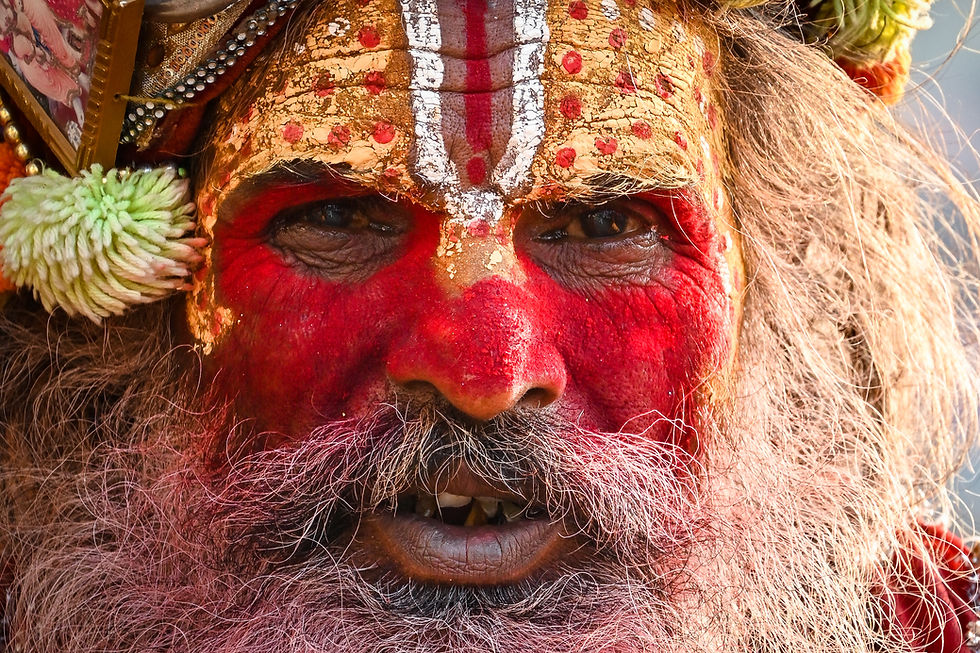
Of course, Nepal is not just about people, needless to say, the landscape is amazing.
This time I didn’t do any long trek, which is something I still consider and I promised myself I’ll do one day (…before getting to old for that!). So, this time I kept it simple: just day hikes around Sarangkot and Nagarkot, which offer some of the best views Nepal has to offer.
From both places Himalaya chain look incredibly close, almost within reach, even though you know they are not. It feels like a backdrop, like something added later, except it is very much real.
Photographically, it is one of those situations where you do not need to overthink things: just a bit of exposure adjustment, careful attention to highlights, making sure the snow does not completely blow out. Nothing particularly complex, but still requiring some attention.
Some of those images ended up being quite dramatic (which is something I always like in photography) and among my favorites of the entire trip, but probably not because they are technically perfect, but because they capture that sense of scale, that slightly unreal feeling you get when you are there.
Pokhara, Where Things Started to Come Together

If there is one place where I really spent time with the camera, that was Pokhara.
Pokhara has a completely different rhythm compared to the capital Kathmandu and its neighbor cities. It is quieter, more relaxed, centered around its lake, with life going slowly along the water. After the density of Kathmandu, it almost feels like a blessing.
And for photography, it was also another perfect spot. The combination is almost too good to be true: landscape in the background, the lake acting as a reflective surface, colorful boats scattered along the shore and people moving through the scene.
I spent hours walking along the lake, stopping whenever something caught my attention and often this was the contrast between the bright colors of the boats and the softer tones of the surroundings.
This is also where I tried to push my usual experiments a bit further. Multiple exposure in this kind of environment is different: you don’t have the structured chaos of a city, the layers of reflections from glass and metal, so the approach has to change.
I started working with reflections on the water, combining them with elements from the shore, layering boats, people and fragments of landscape. Not all attempts worked, but when I started to focus on minimalism then the results arrived.
At some point I noticed a few balloons floating across the lake with the mountains in the background, and I focused on a minimal composition with just a few elements and an almost monochromatic palette. Those shots ended up being among my favorites from the trip.
These shots had a different quality compared to my usual work, where normally color is always a strong element: these were less aggressive, more calm and meditative, definitely a territory that I feel I want to explore more.

Closing thoughts
What stays of my trip in this wonderful country are the faces of the people, the silence of the mountains in the distance, the slow movement of life around the lake in Pokhara.
Every place leaves something different, not always something you can represent in your images, but something that stays anyway.
…and that is usually enough to make you want to go back there again sooner or later.


Comments