
How to see things differently: my personal journey into abstract photography

How ordinary things hide beauty
Abstract photography sounds like one of those things that only gallery people understand while the rest of us look at with a confused smile. But the truth is more simple and much more fun. Abstract work starts the moment you stop looking at things for what they are and start looking at them for what they could become. Many artists from the past played with this way of looking. Domenico Gnoli for example built whole paintings from tiny details that most people would never even notice. A shirt collar a fold of fabric a piece of hair. He turned these ordinary elements into entire worlds. A similar approach has inspired photographers too, like Aaron Siskind who dedicated his work into transforming peeling walls, cracked paint and everyday surfaces into striking abstract compositions, proving that even the most ordinary things can become extraordinary when seen differently.
We live surrounded by objects that look insignificant, they stay there doing nothing special. However, if you get close and if you give them a bit of attention they often reveal something surprising. Even the ugliest corner or the saddest piece of metal can hide a detail that shines and deserves to be captured: when you isolate that detail and show it in the right way you get something that feels bigger than the object itself.
This is where abstract photography (and art in general) becomes a game.

Night walks and reflections
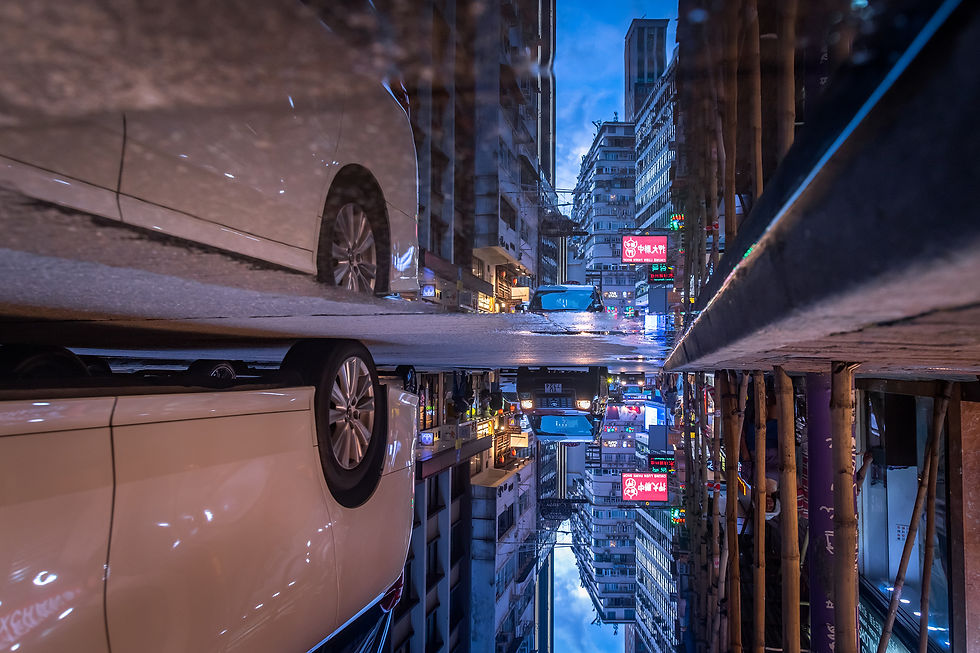
My own journey into it happened quite naturally. If you know me you know that my natural playground is multiple exposure. I feel in what people call "comfort zone" (yeah, I know, I hate that term too...) when I stack things on top of other things until I reach a point of happy confusion. But one night in Hong Kong I decided to go out of this path and stay pure and simple. So I picked my camera and started a night walk with the idea of shooting only abstract compositions.
Of course this was easier to say than to do. When you stop thinking in classic subjects you suddenly realize that the city is full of strange opportunities. Most of them hide in plain sight waiting for someone curious enough to notice them.
Cars for example: on that night I looked at them with a different attitude.
I started to pay attention to the reflections on their body. The curves the coloured lights the unexpected distortions. I found myself chasing bumpers and doors like a detective who finally found an interesting case. Cars if shiny enough are almost like mirrors and if you want to practice abstract photography they can be a fantastic subject.
My eye was mainly focusing on the small intersections of form, the thin shadow line where the door meets the body and what surprised me was that you don't necessarily need a glossy surface: even a matte finish could be fascinating. No mirror effect no glossy glamour, but a subtle texture. The light doesn’t bounce so much, but it stays softly on the surface, creating gentle gradients and a velvety darkness that feels almost secretive.
Glossy cars shout, matte cars whisper. Both are worth listening to.

This new mindset followed me everywhere during that walk. I began to notice surfaces that until that moment had blended into the background.
Another day, for example, I passed by a shop in Tsim Sha Tsui, one of those famous, glamorous brands (I cannot remember which one though...). I just remember an interesting, geometric cladding on its facade. It had this strange rhythm of lines in shades of grey with a touch of ochre here and there. Hundreds of people were walking in front of it without even looking, too busy with their shopping plans or their messages. Meanwhile I was the only person standing there like a confused tourist trying to understand why a wall was suddenly so fascinating.
The result was an abstract photograph, almost monochrome, geometric and elegant and when I tried rotating the pattern at 45° in post-production, I realized that it worked even better.
All this felt incredibly satisfying, a reminder that even the smallest, most insignificant detail can reveal an entire world, if you’re willing to stop and really look.

Making abstraction a habit
When you slow down and let your eyes wander into the small details around you, a scratched surface, a reflection on a shop window, a plastic cover on a street sign...even dirty windows can become compelling compositions. The more ordinary the object the greater the reward. When you shift your vision from big scenes to tiny fragments everything becomes a potential subject. Nothing is too ordinary.
There is also a playful side to all of this. Abstract photography lets you forget the pressure of capturing the perfect moment or the perfect composition. Instead you enjoy the act of discovering. You start to see the city like a giant puzzle full of shapes and reflections and colours.
If you want to try it yourself start with what you already have around you. Do not wait for a dramatic scene or a famous building. Start with the things you pass every day. Get close. Look again. And if someone gives you strange looks while you photograph a car door do not worry. You are just learning how to see differently. And that is exactly where the fun begins.
So, what is the most ordinary thing around you that could become your next abstract shot?


Comments